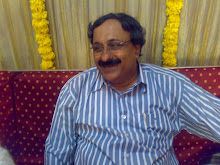
This one by the great poet has always inspired me
If you can keep your head when all about you
Are losing theirs and blaming it on you;
If you can trust yourself when all men doubt you,
But make allowance for their doubting too;
If you can wait and not be tired by waiting,
Or, being lied about, don't deal in lies,
Or, being hated, don't give way to hating,
And yet don't look too good, nor talk too wise;
If you can dream - and not make dreams your master;
If you can think - and not make thoughts your aim;
If you can meet with triumph and disaster
And treat those two imposters just the same;
If you can bear to hear the truth you've spoken
Twisted by knaves to make a trap for fools,
Or watch the things you gave your life to broken,
And stoop and build 'em up with wornout tools;
If you can make one heap of all your winnings
And risk it on one turn of pitch-and-toss,
And lose, and start again at your beginnings
And never breath a word about your loss;
If you can force your heart and nerve and sinew
To serve your turn long after they are gone,
And so hold on when there is nothing in you
Except the Will which says to them: "Hold on";
If you can talk with crowds and keep your virtue,
Or walk with kings - nor lose the common touch;
If neither foes nor loving friends can hurt you;
If all men count with you, but none too much;
If you can fill the unforgiving minute
With sixty seconds' worth of distance run -
Yours is the Earth and everything that's in it,
And - which is more - you'll be a Man my son!
Saturday, November 19, 2011

Saturday, October 29, 2011
The Law of the Garbage Truck™ by David J. Pollay
How often do you let other people’s nonsense change your mood? Do you let a bad driver, rude waiter, curt boss, or an insensitive employee ruin your day? Unless you’re the Terminator, you’re probably set back on your heels. However, the mark of your success is how quickly you can refocus on what’s important in your life. Sixteen years ago I learned this lesson. And I learned it in the back of a New York City taxi cab. Here’s what happened.
I hopped in a taxi, and we took off for Grand Central Station. We were driving in the right lane when all of a sudden, a black car jumped out of a parking space right in front of us. My taxi driver slammed on his brakes, the car skidded, the tires squealed, and at the very last moment our car stopped just one inch from the other car’s back-end.
I couldn’t believe it. But then I couldn’t believe what happened next. The driver of the other car, the guy who almost caused a big accident, whipped his head around and he started yelling bad words at us. How do I know? Ask any New Yorker, some words in New York come with a special face. And for emphasis, he threw in a one finger salute, as if his words were not enough.
But then here’s what really blew me away. My taxi driver just smiled and waved at the guy. And I mean, he was friendly. So, I said, “Why did you just do that!? This guy could have killed us!” And this is when my taxi driver told me what I now call, “The Law of the Garbage Truck™.” He said:
Many people are like garbage trucks. They run around full of garbage, full of frustration, full of anger, and full of disappointment. As their garbage piles up, they look for a place to dump it. And if you let them, they’ll dump it on you.
So when someone wants to dump on you, don’t take it personally. Just smile, wave, wish them well, and move on. Believe me. You’ll be happier.
So I started thinking, how often do I let Garbage Trucks run right over me? And how often do I take their garbage and spread it to other people at work, at home, or on the street? It was then that I said, “I don’t want their garbage and I’m not going to spread it anymore.”
I began to see Garbage Trucks. Like in the movie “The Sixth Sense,” the little boy said, “I see Dead People.” Well now “I see Garbage Trucks.” I see the load they’re carrying. I see them coming to dump it. And like my taxi driver, I don’t take it personally; I just smile, wave, wish them well, and I move on.
One of my favourite football players of all time is Walter Payton. Every day on the football field, after being tackled, he would jump up as quickly as he hit the ground. He never dwelled on a hit. Payton was ready to make the next play his best. Over the years the best players from around the world in every sport have played this way: Tiger Woods, Nadia Comaneci, Muhammad Ali, Bjorn Borg, Chris Evert, Michael Jordan, and Pele are just some of those players. And the most inspiring leaders have lived this way: Nelson Mandela, Mother Theresa, Gandhi, and Martin Luther King.
See, Roy Baumeister, a psychology researcher from Florida State University, found in his extensive research that you remember bad things more often than good things in your life. You store the bad memories more easily, and you recall them more frequently.
So the odds are against you when a Garbage Truck comes your way. But when you follow The Law of the Garbage Truck™, you take back control of your life. You make room for the good by letting go of the bad.
The best leaders know that they have to be ready for their next meeting. The best sales people know that they have to be ready for their next client. And the best parents know that they have to be ready to welcome their children home from school with hugs and kisses, no matter how many garbage trucks they might have faced that day. All of us know that we have to be fully present, and at our best for the people we care about.
The bottom line is that successful people do not let Garbage Trucks take over their lives.
What about you? What would happen in your life, starting today, if you let more garbage trucks pass you by?
Here’s my bet: You’ll be happier.
You have a choice. Make it today.
Have a Garbage Free Day! ™
Saturday, October 15, 2011
A Tale of Two Seas
This story was sent by my friend, Rohan, and I liked the perspective which I am sharing.
Sitting in the Geography class in school, I remember how fascinated I was when we were being taught all about the Dead Sea. As you probably recall, the Dead Sea is really a Lake, not a sea (and as my Geography teacher pointed out, if you understood that, it would guarantee 4 marks in the term paper!) It’s so high in salt content that the human body can float easily. You can almost lie down and read a book! The salt in the Dead Sea is as high as 35% - almost 10 times the normal ocean water. And all that saltiness has meant that there is no life at all in the Dead Sea. No fish. No vegetation. No sea animals. Nothing lives in the Dead Sea.
And hence the name: Dead Sea.
While the Dead Sea has remained etched in my memory, I don't seem to recall learning about the Sea of Galilee in my school Geography lesson. So when I heard about the Sea of Galilee and the Dead Sea and the tale of the two seas - I was intrigued.
Turns out that the Sea of Galilee is just north of the Dead Sea. Both the Sea of Galilee and the Dead Sea receive their water from river Jordan. And yet, they are very, very different.
Unlike the Dead Sea, the Sea of Galilee is pretty, resplendent with rich, colorful marine life. There are lots of plants. And lots of fish too. In fact, the Sea of Galilee is home to over twenty different types of fishes.
Same region, same source of water, and yet while one sea is full of life, the other is dead. How come?
Here’s apparently why. The River Jordan flows into the Sea of Galilee and then flows out. The water simply passes through the Sea of Galilee in and then out - and that keeps the sea healthy and vibrant, teeming with marine life.
But the Dead Sea is so far below the mean sea level, that it has no outlet. The water flows in from the river Jordan, but does not flow out. There are no outlet streams. It is estimated that over 7 million tons of water evaporate from the Dead Sea every day. Leaving it salty. Too full of minerals. And unfit for any marine life.
The Dead Sea takes water from the River Jordan, and holds it. It does not give.
Result? No life at all.
Think about it.
Life is not just about getting. Its about giving. We all need to be a bit like the Sea of Galilee.
We are fortunate to get wealth, knowledge, love and respect. But if we don't learn to give, we could all end up like the Dead Sea. The love and the respect, the wealth and the knowledge could all evaporate. Like the water in the Dead Sea.
If we get the Dead Sea mentality of merely taking in more water, more money, more everything the results can be disastrous.
Good idea to make sure that in the sea of your own life, you have outlets. Many outlets. For love and wealth - and everything else that you get in your life. Make sure you don't just get, you give too.
Open the taps. And you'll open the floodgates to happiness. Make that a habit. To share. To give.
And experience life. Experience the magic!
Thursday, September 22, 2011
That's how it is!
A young man called Rama Swami died an untimely death.
They all happened to be disciples of a holy man whom they called 'Maharaj Ji'. His parents, wife and nine year old son were crying bitterly sitting next to his dead body. When Maharaj Ji learnt that Rama Swami had died, he came vo visit the family.
He entered the house and found the family wailing unconsolably. Seeing Maharaj Ji, the wife started crying even louder. She sobbed saying, "Maharaj Ji, he has died too early, he was so young... I'm so helpless and miserable."
Oh! I would do anything to make him alive again. What will happen to our son?
Maharaj Ji tried to pacify the crying lady and the old parents,
But the loss was too much for them to come to terms with so easily.
Eventually, Maharaj Ji said, "Alright, get me a glass of water."
Maharaj Ji sat near the dead body and put the glass next to it.
Rama Swami shall come back to life, but the person who drinks the water shall die
There was pin drop silence..!
He said, "Now, who ever wants that Rama Swami should become alive again, may drink this water. "Come, did you not say that Rama Swami was the sole bread winner of the family? Who would die instead of him? It is a case of fair exchange, isn't it?"
The wife looked at the old mother and the old mother looked at the wife. The old father looked at Rama Swami's son.
But no one came forward...
Then Maharaj Ji said to the old father, "Babuji, wouldn't you give your life for your son?" The old man said, "Well, I have my responsibility towards my wife. If I die who will look after her? I cannot offer my life."
Maharaj Ji asked the son, "Well little boy, would you like to give your life for your father?" The child's mother said "Maharaj Ji,are you insane?..My son is only nine. He has not yet lived his life." All others had their genuine reasons to present.
Maharaj Ji said, "Well it seems, that all of you are very much needed for the things you need to do in this world... It seems Rama Swami was the only one that could be spared... That is why God chose to take him away.
So shall we now proceed with his last rites?... It's getting late. Having said that, Maharaj Ji got up and left.
In the words of a learned man ... "We tend a plant only when the leaves are green; the rest are only memories of happy times..! Further, God has a great design for every individual human being, and they have their role to play in this game on earth."
... Have a Great Day ...
Thursday, September 8, 2011
Flying creature in crystal river: Story of a messiah
This piece is from “Illusions” – by Richard Bach
Once there lived a village of creatures along the bottom of a great crystal river.
The current of the river swept silently over them all – young and old, rich and poor, good and evil, the current going its own way knowing only its own crystal self.
Each creature in its own manner clung tightly to the twigs and rocks of the river bottom, for clinging was their way of life, and resisting the current what each had learned from birth.
But one creature said at last. “I am tired of clinging. Though I cannot see it with my eyes, I trust that the current knows where it is going. I shall let go, and let it take me where it will. Clinging, I shall die of boredom.
The other creatures laughed and said: “Fool! Let go, and that current you worship will throw you tumbled and smashed across the rocks, and you will die quicker than boredom!”
But the one heeded them not, and taking a breath let go, and at once was tumbled and smashed by the current across the rocks.
Yet in time, as the creature refused to cling again, the current lifted him free from the bottom and he was bruised no more.
And the creatures downstream, to whom he was a stranger, cried, “See a miracle! A creature like ourselves, yet he flies! See the Messiah, come to save us all!”
And the one carried in the current said. “I am no more Messiah than you. The river delights to lift us free, if only we dare let go. Our true work is this voyage, this adventure.”
But they cried the more, “Saviour!” all the while clinging to the rocks, and when they looked again, he was gone, and they were left alone making legends of a Saviour.”
Moral: “What you hold on to most dear will always hold you back!!”
Sunday, August 28, 2011
Parable of Ups and Downs
This is a parable by Dr. Robert Terry which was read out to us in a development programme. I am reproducing the same.
What makes an UP an UP and a DOWN a DOWN is that an UP can do more to a DOWN than a DOWN can do to an UP. That’s what keeps an UP UP and a DOWN DOWN. The UPS tend to talk to each other and study the DOWNS, asking the DOWNS about what’s UP, or what’s coming DOWN, for that matter. The DOWNS spend a lot of time taking the UPS out to lunch or dinner, to explain their DOWNNESS. The UPS listen attentively, often in amazement about the experiences of being a DOWN. They contrast one DOWN’S experience with another DOWN’S experience and usually don’t worry too much about what the DOWNS are UP to because the DOWNS never get together. If they did, the UPS would have to shape UP.
After a while, the DOWNS are weary of talking to the UPS. They tire of explaining and justifying their DOWNNESS. They think, “If I have to explain my DOWNNESS one more time, I’ll throw UP.” And so they form a process which they call “networking and support groups.” This act makes the UPS nervous. Three UPS together is a board meeting; three DOWNS - a pre-revolutionary activity! Some UPS hire DOWNS, dress them UP, send them DOWN to see what DOWNS are UP to. We sometimes call this “personnel and affirmative action.” This creates a serious problem for the DOWN who is dressed UP with no sure place to go. That DOWN doesn’t know whether he or she is UP or DOWN. That’s why DOWNS in the middle often burn out.
Sometimes what the UPS do to smarten UP is to ask the DOWNS to come in to a program one at a time to explain their DOWNNESS. UPS call this “human relations training.” OF course, the UPS never have to explain their UPNESS, that’s why they’re UPS rather than DOWNS.
There’s good news and bad news in this parable. The good news is, we’re all both UPS and DOWNS. There’s no such thing as a perfect UP or a perfect DOWN. The bad news is that when we’re UP it often makes us stupid. We call that “DUMB-UPNESS.” It’s not because UPS are not smart. It’s that UPS don’t have to pay attention to DOWNS the way that DOWNS have to pay attention to UPS. DOWNS always have to figure out what UPS are UP to. The only time UPS worry about DOWNS is when DOWNS get uppity, at which time they’re put DOWN by the UPS. The UPS’ perception is that DOWNS are overly sensitive; they have an attitude problem. It’s never understood that UPS are underly sensitive and have an attitude problem.
I used to think that when DOWNS became UPS they would carry over their insight from their DOWNNESS to their UPNESS. Not so. Smart DOWN—dumb UP.
Monday, August 22, 2011
The Power of Positive Talk
An interesting article that I read some years ago.
I remember my dad teaching me the power of language at a very young age. Not only did my dad understand that specific words affect our mental pictures, but he understood words are a powerful programming factor in lifelong success.
One particularly interesting event occurred when I was eight. As a kid, I was always climbing trees, poles, and literally hanging around upside down from the rafters of our lake house. So, it came to no surprise for my dad to find me at the top of a 30-foot tree swinging back and forth. My little eight-year-old brain didn't realize the tree could break or I could get hurt. I just thought it was fun to be up so high.
My older cousin, Tammy, was also in the same tree. She was hanging on the first big limb, about ten feet below me. Tammy's mother also noticed us at the exact time my dad did. About that time a huge gust of wind came over the tree. I could hear the leaves start to rattle and the tree begin to sway. I remember my dad's voice over the wind yell, "Bart, Hold on tightly." So I did. The next thing I know, I heard Tammy screaming at the top of her lungs, laying flat on the ground. She had fallen out of the tree.
I scampered down the tree to safety. My dad later told me why she fell and I did not. Apparently, when Tammy's mother felt the gust of wind, she yelled out, "Tammy, don't fall!" And Tammy did fall. My dad then explained to me that the mind has a very difficult time processing a negative image.
In fact, people who rely on internal pictures cannot see a negative at all. In order for Tammy to process the command of not falling, her nine-year-old brain had to first imagine falling, then try to tell the brain not to do what it just imagined. Whereas, my eight-year-old brain instantly had an internal image of me hanging on tightly.
This concept is especially useful when you are attempting to break a habit or set a goal. You can't visualize not doing something. The only way to properly visualize not doing something is to actually find a word for what you want to do and visualize that. For example, when I was thirteen years old, I played for my junior high school football team. I tried so hard to be good, but I just couldn't get it together at that age. I remember hearing the words run through my head as I was running out for a pass, "Don't drop it!"
Naturally, I dropped the ball. My coaches were not skilled enough to teach us proper "self-talk." They just thought some kids could catch and others couldn't. I'll never make it pro, but I'm now a pretty good Sunday afternoon football player, because all my internal dialogue is positive and encourages me to win. I wish my dad had coached me playing football instead of just climbing trees. I might have had a longer football career. Here is a very easy demonstration to teach your kids and your friends the power of a toxic vocabulary.
Ask them to hold a pen or pencil. Hand it to them. Now, follow my instructions carefully. Say to them, "Okay, try to drop the pencil." Observe what they do. Most people release their hands and watch the pencil hit the floor. You respond, "You weren't paying attention. I said TRY to drop the pencil. Now please do it again." Most people then pick up the pencil and pretend to be in excruciating pain while their hand tries but fails to drop the pencil.
The point is made. If you tell your brain you will "give it a try," you are actually telling your brain to fail. I have a "no try" rule in my house and with everyone I interact with. Either people will do it or they won't. Either they will be at the party or they won't. I'm brutal when people attempt to lie to me by using the word try. Do they think I don't know they are really telegraphing to the world they have no intention of doing it but they want me to give them brownie points for pretended effort?
You will never hear the words "I'll try" come out of my mouth unless I'm teaching this concept in a seminar. If you "try" and do something, your unconscious mind has permission not to succeed. If I truly can't make a decision I will tell the truth. "Sorry John. I'm not sure if I will be at your party or not. I've got an outstanding commitment. If that falls through, I will be here. Otherwise, I will not. Thanks for the invite."
People respect honesty. So remove the word "try" from your vocabulary.
My dad also told me that psychologists claim it takes seventeen positive statements to offset one negative statement. I have no idea if it is true, but the logic holds true. It might take up to seventeen compliments to offset the emotional damage of one harsh criticism. These are concepts that are especially useful when raising children. Ask yourself how many compliments you give yourself daily versus how many criticisms. Heck, I know you are talking to yourself all day long. We all have internal voices that give us direction. So, are you giving yourself the 17:1 ratio or are you shortchanging yourself with toxic self-talk like, "I'm fat. Nobody will like me. I'll try this diet. I'm not good enough. I'm so stupid. I'm broke, etc. etc."
If our parents can set a lifetime of programming with one wrong statement, imagine the kind of programming you are doing on a daily basis with your own internal dialogue.
Here is a list of Toxic Vocabulary words. Notice when you or other people use them.
But: Negates any words that are stated before it.
Try: Presupposes failure.
If: Presupposes that you may not.
Might: It does nothing definite. It leaves options for your listener.
Would Have: Past tense that draws attention to things that didn't actually happen.
Should Have: Past tense that draws attention to things that didn't actually happen (and implies guilt.)
Could Have: Past tense that draws attention to things that didn't actually happen but the person tries to take credit as if it did happen.
Can't/Don't: These words force the listener to focus on exactly the opposite of what you want. This is a classic mistake that parents and coaches make without knowing the damage of this linguistic error.
Examples:
Toxic phrase: "Don't drop the ball!"
Likely result: Drops the ball
Better language: "Catch the ball!"
Toxic phrase: "You shouldn't watch so much television."
Likely result: Watches more television.
Better language: "I read too much television makes people slow.”
That's the power of positive talk.
Subscribe to:
Posts (Atom)