Sunday, August 11, 2013

The path of the calf

One  day  through  the  primeval wood a  calf  walked  home  as  good  calves  should;
but made  a  trail  all  bent  askew, a  crooked  trail  as  calves  all  do.
Since  then  three  hundred  years  have  fled, and  I  infer  the  calf  is  dead;
but  still  he  left  behind  his  trail, and thereby  hangs my moral  tale.
The  trail was  taken  up  next  day,  by  a  lone  dog  that  passed  that way;
and  then  a  wise  bellwether  sheep pursued  the  trail  over  vale,
and  steep and  drew  the  flock  behind  him  too, as  good  bellwethers  always  do.
And  from  that  day over hill and  glade, through  these old woods a  path  was made;
and many men  wound  in  and  out, and  dodged  and  turned  and  bent  about;
and  uttered  words  of  righteous  wrath because  it was  such  a  crooked  path.
But  still  they  followed, do  not  laugh the  first migrations  of  that  calf.
This  forest  path  became  a  lane that  bent  and  turned  and  turned again.
This  crooked  lane  became  a  road, where many  a  poor  horse  with  his  load,
toiled  on  beneath  the  burning  sun and  traveled  some  three miles  in  one.
And  thus  a  century  and  a  half,  they  trod  the  footsteps  of  that  calf.
The  years  passed  on  in  swiftness  fleet,  the  road  became  a  village  street;
and  this,  before men  were  aware, a  city’s  crowded  thoroughfare.
And  soon  the  central  street  was  this, the  hub  of  a  renowned metropolis.
And men  two  centuries  and  a  half trod  in  the  footsteps  of  that  calf.
A  hundred  thousand men  were  led by  one  calf  near  three  centuries  dead.
For  we  are  prone  to  go  it  blind along  the  calf-paths  of  the mind,
and  work  away  from  sun  to  sun to  do  what  other  folks  have  done.
We  follow  in  the  beaten  track, and  out  and  in,  and  forth  and  back;
and  still  our  devious  course  pursue, to  keep  the  path  that  others  do.
We  keep  the  path  a  sacred  groove along  which  all  our  lives  we move,
But  how  the  wise  old  wood  gods  laugh who  saw  that  first  primeval  calf!
 
Sam  Walter  Foss

Sunday, April 21, 2013


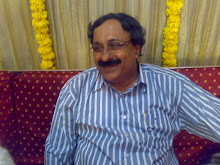
My good friend RS

A lot of us called him RS, and family members and relatives called him Bhai saab or Bablu. The children called him ‘Pappa’. A wonderful human being, loved by one and all and a gentleman to the core was RS. He passed away on 13th April, this year after a brief illness.

I knew RS  for the last 30 years since I joined Ambassador Sky Chef, and since then he has been a close friend of mine. He was dedicated to his work and proved the tenet ‘ Work is Worship.’ He was an engineer by profession and many of the hotels and malls that we visit, bear  his stamp of excellence. He worked tirelessly and his definition of excellence was heaven.

RS has a lovely family  consisting of his wife, Chanda Bhabhi, and three daughters, Pooja, Preeti and Poonam. RS always told me that he never had to worry about his family and the upbringing of the children because of Chanda Bhabhi.  But RS was a doting father and showered love and affection not only on  his wife and children but also his other family members and the fraternity. The number of people on his 60th birthday celebrations on 15th April last year bore testimony for his popularity and the kind of bond that he had enjoyed with one and all.  My wife and I attended the function and we were moved to tears seeing the warmth, love and affection that RS shared with his family, friends and other well wishers.  I recall RS dancing  and clapping throughout the function  despite his sickness.  

Now what was RS to me? A close friend, confidante and a great human being. He was the key figure and the friend instrumental for my marriage. I could rely and count on him when in need, and he was always one who asked whether he could be of help. And this quality endeared him to one and all, and I am aware he has helped a lot of people in living their lives. RS has left his footsteps on the sands of time. Footsteps that teach us how to live with humility, how to be of help and service to humanity, and finally how to spread love, warmth and affection.
RS you have been infectious, and as a tribute to your memory and life, we will  continue to live the lessons you have lived all your life. May Your soul rest in peace.

Wednesday, November 14, 2012

WHEN PUSH COMES TO SHOVE

I had read this piece some time ago.
 
A long time ago there was a great General who was faced with a situation which made it necessary for him to make a drastic decision to insure his success on the battlefield. He was about to send his army on shore to face a powerful enemy, whose men outnumbered his.

He loaded his soldiers into boats, and sailed to face the enemies on shore. When they reached the shore, he ordered them to unload the soldiers and cargoes. He then ordered for all the ships and boats to be burned.

Addressing his men before the battle, he said, "You see the ships and boats going up in smoke? That means that we cannot leave these shores alive unless we win! We now, have no choice - either we win, or we perish."

They WON!!!

Friday, October 26, 2012

A Giant Tree

This is a small piece written by Paulo Coelho and I thought I should reproduce the same.
 
 
A carpenter and his apprentices were travelling through the province of Qi in search of building materials.

They saw a giant tree; five men all holding hands could not encompass its girth, and its crown reached almost to the clouds.

“Let’s not waste our time with this tree,” said the master carpenter. “It would take us forever to cut it down. If we wanted to make a ship out of that heavy trunk, the ship would sink. If we tried to use it to build a roof, the walls would have to be specially reinforced.”

The group continued on its way. One of the apprentices remarked:

“Such a big tree and no use to anyone!”

“That’s where you’re wrong,” said the master carpenter. “The tree was true to its own destiny.”

“If it had been like all the others, we would have cut it down. But because it had the courage to be different, it will remain alive and strong for a long time yet.”

~ Paulo Coelho

Sunday, June 3, 2012

Let them know young

In an interview of a young boy, the director discovered from the CV that the youth's academic achievements were excellent all the way, from the secondary school until the postgraduate research, never had a year when he did not score.

The director asked, "Did you obtain any scholarships in school?" the youth answered "none".

The director asked, " Was it your father who paid for your school fees?"
The youth answered, "My father passed away when I was one year old, it was my mother who paid for my school fees.

The director asked, " Where did your mother work?" The youth answered, "My mother worked as clothes cleaner. The director requested the youth to show his hands. The youth showed a pair of hands that were smooth and perfect.

The director asked, " Have you ever helped your mother wash the clothes before?" The youth answered, "Never, my mother always wanted me to study and read more books. Furthermore, my mother can wash clothes faster than me.

The director said, "I have a request. When you go back today, go and clean your mother's hands, and then see me tomorrow morning.

The youth felt that his chance of landing the job was high. When he went back, he happily requested his mother to let him clean her hands. His mother felt strange, happy but with mixed feelings, she showed her hands to the kid.

The youth cleaned his mother's hands slowly. His tear fell as he did that.
It was the first time he noticed that his mother's hands were so wrinkled, and there were so many bruises in her hands. Some bruises were so painful that his mother shivered when they were cleaned with water.

This was the first time the youth realized that it was this pair of hands that washed the clothes everyday to enable him to pay the school fee. The bruises in the mother's hands were the price that the mother had to pay for his graduation, academic excellence and his future.

After finishing the cleaning of his mother hands, the youth quietly washed all the remaining clothes for his mother.

That night, mother and son talked for a very long time.

Next morning, the youth went to the director's office.

The Director noticed the tears in the youth's eyes, asked: "Can you tell me what have you done and learned yesterday in your house?"

The youth answered, "I cleaned my mother's hand, and also finished cleaning all the remaining clothes'

The Director asked, "Please tell me your feelings."

The youth said, Number 1, I know now what appreciation is. Without my mother, there would not the successful me today. Number 2, by working together and helping my mother, only I now realize how difficult and tough it is to get something done. Number 3, I have come to appreciate the importance and value of family relationship.

The director said, " This is what I am looking for to be my manager.
I want to recruit a person who can appreciate the help of others, a person who knows the sufferings of others to get things done, and a person who would not put money as his only goal in life. You are hired.

Later on, this young person worked very hard, and received the respect of his subordinates. Every employee worked diligently and as a team. The company's performance improved tremendously.

A child, who has been protected and habitually given whatever he wanted, would develop "entitlement mentality" and would always put himself first.
He would be ignorant of his parent's efforts. When he starts work, he assumes that every person must listen to him, and when he becomes a manager, he would never know the sufferings of his employees and would always blame others. For this kind of people, who may be good academically, may be successful for a while, but eventually would not feel sense of achievement.
He will grumble and be full of hatred and fight for more. If we are this kind of protective parents, are we really showing love or are we destroying the kid instead?*

You can let your kid live in a big house, eat a good meal, learn piano,watch a big screen TV. But when you are cutting grass, please let them experience it. After a meal, let them wash their plates and bowls together with their brothers and sisters. It is not because you do not have money to hire a maid, but it is because you want to love them in a right way. You want them to understand, no matter how rich their parents are, one day their hair will grow gray, same as the mother of that young person. The most important thing is your kid learns how to appreciate the effort and experience the difficulty and learns the ability to work with others to get things done.

Monday, May 28, 2012

The wisdom of a mountain


In ancient China, on top of Mount Ping stood a temple where the enlightened
one, Hwan, dwelled. Of his many disciples, only one is known to us, Lao-li. For more than 20 years, Lao-li studied and meditated under the great master, Hwan. Although Lao-li was one of the brightest and most determined of disciples, he had yet to reach enlightenment. The wisdom of life was not his.

Lao-li struggled with his lot for days, nights, months, even years until
one morning, the sight of a falling cherry blossom spoke to his heart.
"I can no longer fight my destiny," he reflected.
"Like the cherry blossom, I must gracefully resign myself to my lot."

From that moment forth, Lao-li determined to retreat down the mountain, giving up his hope of enlightenment. Lao-li searched for Hwan to tell him of his decision. The master sat before a white wall, deep in meditation. Reverently, Lao-li approached him.

"Enlightened one," he said.But before he could continue, the master spoke,
"Tomorrow I will join you on your journey down the mountain." No more needed to be said. The great master understood. The next morning, before their descent, the master looked out into the vastness surrounding the mountain peak. "Tell me, Lao-li," he said, "what do you see?" "Master, I see the sun beginning to wake just below the horizon, meandering hills and mountains that go on for miles, and couched in the valley below, a lake and an old town."

The master listened to Lao-li's response. He smiled, and then they took the first steps of their long descent. Hour after hour, as the sun crossed the sky, they pursued their journey, stopping only once as they approached the foot of the mountain. Again Hwan asked Lao-li to tell him what he saw. "Great wise one, in the distance I see roosters as they run around barns,cows asleep in sprouting meadows, old ones basking in the late afternoon sun, and children romping by a brook."

The master, remaining silent, continued to walk until they reached the gate to the town. There the master gestured to Lao-li, and together they sat under an old tree. "What did you learn today, Lao-li?" asked the master. "Perhaps this is the last wisdom I will impart to you."
 
Silence was Lao-li's response. At last, after long silence, the master continued.
"The road to enlightenment is like the journey down the mountain. It comes only to those who realize that what one sees at the top of the mountain is not what one sees at the bottom. Without this wisdom, we close our minds to all that we cannot view from our position and so limit our capacity to grow and improve. But with this wisdom, Lao-li, there comes an awakening. We recognize that alone one sees only so much - which, in truth, is not much at all. This is the wisdom that opens our minds to improvement, knocks down prejudices, and teaches us to respect what at first we cannot view.
 
Never forget this last lesson, Lao-li: what you cannot see can be seen from a different part of the mountain." When the master stopped speaking, Lao-li looked out to the horizon, and as the sun set before him, it seemed to rise in his heart. Lao-li turned to the master, but the great one was gone. So the old Chinese tale ends. But it has been said that Lao-li returned to the mountain to live out his life. He became a great enlightened one.

Harvard Business Review
Parables of Leadership
by W. Chan Kim and Renee A. Mauborgne

Wednesday, March 7, 2012

WONDERS AND WONDERFUL

A group of geography students studied the Seven Wonders of the World. At the end of that section, the students were asked to list what they considered to be the Seven Wonders of the World.
Though there was some disagreement, the following got the most votes:
Egypt's Great Pyramids, Taj Mahal, Grand Canyon, Panama Canal, Empire State Building, St. Peter's Basilica and China's Great Wall.

While gathering the votes, the teacher noted that one student, a quiet girl, hadn't
turned in her paper yet. So she asked the girl if she was having trouble with her list. The quiet girl replied, "Yes, a little. I couldn't quite make up my mind because there were so many." The
teacher said, "Well, tell us what you have, and maybe we can help." The girl hesitated, then read, "I think the Seven Wonders of the World are:"
to touch, to taste, to see, to hear ....
She hesitated a little, and then added ... to run, to laugh and to love.

It is far too easy for us to look at the exploits of man and refer to them as "wonders" while we overlook all God has done, regarding them as merely "ordinary." May you be reminded today of those things which are truly wondrous and colorful.
HAPPY HOLI - FESTIVAL OF COLOURS